
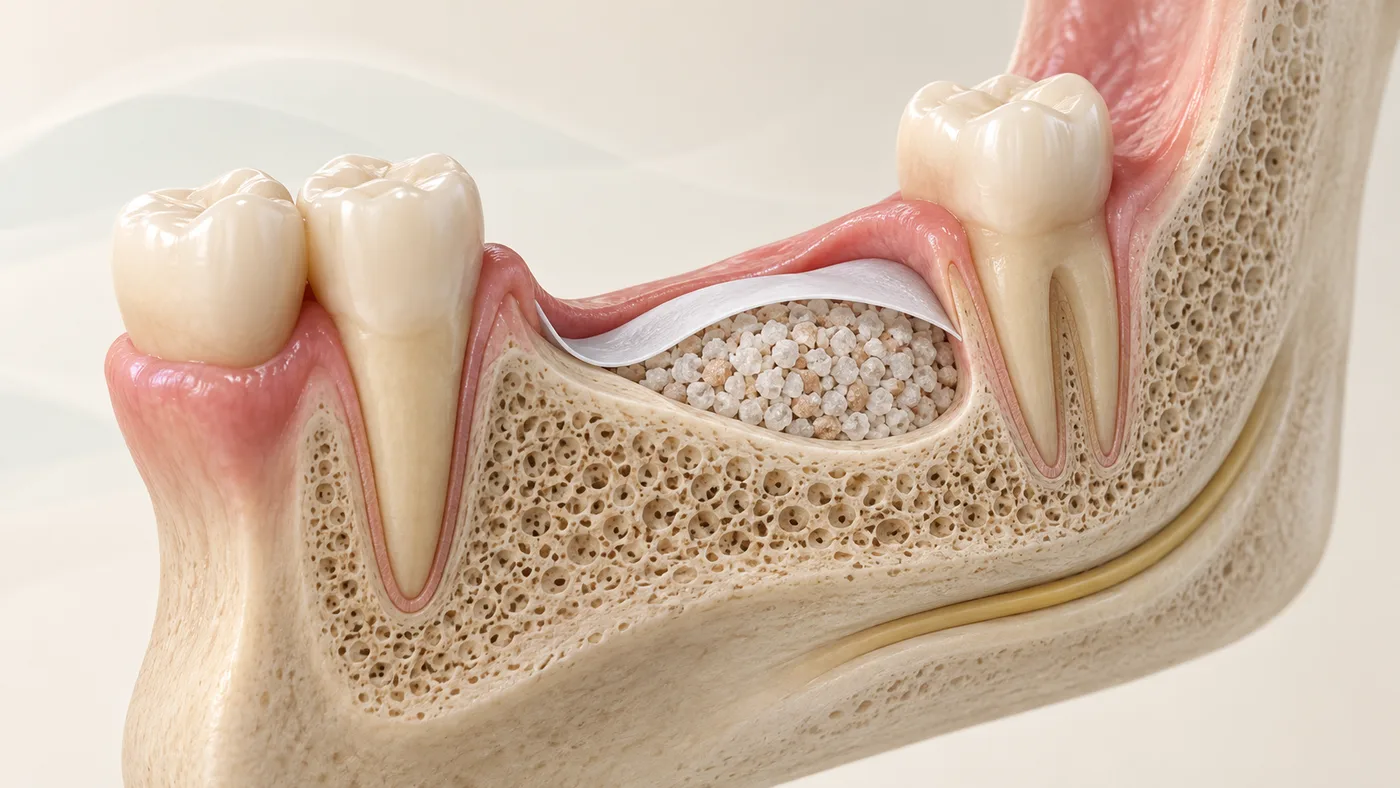
The question is about the planned restoration
The clinician asks whether bone and soft tissue can support an implant in a position that serves the final teeth. Placing an implant wherever bone happens to remain can create restorative or hygiene problems.
How the decision is made
Clinical examination and selected imaging assess the ridge, nearby structures, and defect pattern. Some defects may be treated alongside implant placement; others require a separate healing stage.
Know the alternatives
A different restorative design, a carefully selected alternative implant plan, or a non-implant replacement may sometimes avoid grafting. Each option has trade-offs; “graft-free” is not automatically better.
Ask about the proposed material
Discuss its source, purpose, expected healing, and possible complications such as infection, exposure, incomplete regeneration, or the need for additional treatment.
A generic diagram cannot show whether you need grafting. Ask the dentist to relate the recommendation to your own anatomy and intended restoration.
Bone and gum grafting are different
Bone augmentation aims to provide an appropriate hard-tissue envelope. Soft-tissue grafting addresses selected problems such as tissue thickness or coverage. Neither substitutes for the other, and not everyone needs both.
Ask about graft origin and timing
Options may include your own bone or processed donor, animal-derived or synthetic substitutes, sometimes combined. Selection depends on the defect and procedure; “natural” or “synthetic” does not guarantee a result. Near an upper back-tooth site, sinus augmentation may be considered alongside alternative implant or restorative plans. Ask whether placement can occur with grafting or should wait. A calendar date alone does not prove readiness.